Saturday, May 9, 2026

The Story Behind the Headlines?

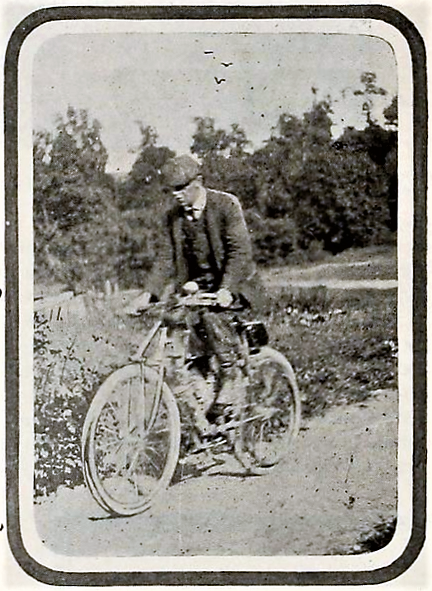
California Motor Company offers bicycle racer George Wyman $500 prize money to ride their motor-bicycle from San Francisco to New York City.  The Goodman Company gets exclusive rights to publish the story and helps with the trip expenses.

Filling the holes of the Wyman saga based on reliable and verifiable sources is a pains taking process.  Very much like a detective following leads, running down rumors and piecing the timeline together.  Sometimes, a new piece of the puzzle helps others fall into place.  When a new bit of the history surfaces, the Wyman Project is eager to share with the public.  Speculating about historical events beyond that supported by documented facts is a risky undertaking.  We want to present the information in historical context, offering reasonable assumptions about the circumstances surrounding new information.  The Wyman Project is very curious about the circumstances leading up to the first crossing of America by motorized vehicle. What were the stakeholders interests and motivations?  What did each hope to gain?  What follows is speculation about the story behind the documented tidbits.  We preface our assumptions with the phrase, "It is likely..."

FOLLOW THE MONEY - Investigations by Marti Wyman Schein, Research Director of the Wyman Project, and those published by Road Rider Magazine in September of 1988 point to a collaboration of the California Motor Company (CMC) and the Goodman Company, publisher of The Motorcycle Magazine, bank rolling much of, if not all of Wyman's historic 1903 journey.  It is likely the CMC put up prize money and would provide technical support.  The Goodman Company likely covered most of Wyman's trip expenses in exchange for exclusive story rights.  Wyman would keep a day-to-day journal and submit regular reports to the Goodman Company.

Dateline May 21, 1903 - Reno Gazette-Journal:  This news clipping confirms other rumors that Wyman would receive a $500 prize (Over $18,000 in 2026 dollars) if he arrived in New York City within 40 days from leaving San Francisco.  It is likely this information came from Wyman himself, given to the reporter for the Gazette-Journal.  Wyman was always eager to tell his story to the local news.  It was repeated in the Winnemucca paper a few days later.

The researchers at Road Rider Magazine make the case the CMC may have been heavily involved with the Wyman adventure.  The questions raised in that article are still unanswered to this day, as all records of the behind the scenes activities and motivations of the CMC owners are long gone.  But, the chronology of the events, juxtaposed with the contemporaneous reporting suggests a collaboration.  The California motor-bicycle was competing with scores of other motorized cycles.  Having invested large sums of startup capital in the CMC, the owners would have been eager to show how well the California performed.  (See the Wyman chronology, 1877 - 1959, in the Road Rider article, linked below.)

"America's First Road Rider - THE HISTORY, "Speculation on the Wyman Story" by G.W. 'Oley' Knudsen and Bob Carpenter, Road Rider Magazine, September 1988, Vol 19 Nbr 9

THE CALIFORNIA MOTOR COMPANY - At the turn of the last century, J.W. Leavitt and L.H. Bill owned/operated bicycle shops in the San Francisco, Oakland and San Jose, CA.  In 1901, Leavitt and Bill founded the California Motor Company.  They hired Roy C. Marks as chief mechanical engineer.  Their goal was to mass produce the motorized bicycle, dubbed the 'California', based on Marks design.  The CMC factory was located at the San Francisco bicycle shops at 730 & 309 Larkin Street.  The CMC was struggling to expand the market for its California motor-bicycle.  Something of a 'dud', its first model was just 90cc and 1/2 horsepower.  At that displacement it was prone to mechanical breakdowns as the under powered motor labored to carry a rider.  In 1902 the California was fitted with a larger 200cc, 1.25 HP motor.  If Leavitt & Bill could not make CMC profitable though the sales of the 'California' at least they could make the company attractive on the ever expanding motorcycle production market.

Cycling sports entrepreneurs Leavitt & Bill were active in the bicycle racing scene in the bay area, sponsoring an annual 100 mile bicycle rally event.   They knew top seeded bicycle racer George Wyman.  He participated in the bay area rallies in 1901 and 1902 after his return from Australia. Wyman had an international reputation for hard riding.  While in Australia around 1900 Wyman circumnavigated the continent of Australia on a bicycle, becoming the first American cyclist to do so.  Owing to his reputation for hard riding it is likely Wyman was eager to expand his riding horizons with a motor.  Sometime in 1902, Wyman acquired a California motor-bicycle.  It is not yet known how he came to get the bike, whether new from CMC or used from someone, or how much he paid for it.  Motor-bicycles in 1902 were retailing for between $200 and $250 ($5,000-$6.900 in 2017 dollars).   In July of 1902, Wyman rode 'the California' across the Sierra Nevada Mountains to attend the "Fifty Mile Bicycle Race" in Reno, NV (source:  Bicycling World and Motorcycle Review, page 255, April 1903)  Wyman was the first to ride a motorized vehicle, of any kind, across the Sierra Nevada range.  It was on the ride back to San Francisco that would inspired Wyman to attempt a transcontinental journey.

On August 17th, 1902, a large combined race featuring events for bicycles, motor-bicycles, and automobiles is held at San Francisco's Ingleside Racetrack.  Two California motor-bicycles are entered in the 5th event, a three-mile motor-bicycle handicap.  Wyman attended, but was not one of the California racers.  He was at the event, representing the Bay City Wheelmen, riding in three bicycle races. It is likely he watched the two California and one Thomas motor-bikes race.

Late summer or early fall, 1902, it is likely Wyman and the CMC got together to discuss his transcontinental attempt.  Wyman would need financial and technical support for the journey.  Whether he approached CMC or they came to him, we suspect the company and the racer came to an arrangement.  CMC would have seen the transcontinental attempt as an opportunity to showcase the California.  It is likely, CMC offered Wyman a $500 incentive if he could reach New York City in 40 days.  From their standpoint it was a calculated business decision.  If Wyman pulls it off it would be a huge endorsement of the quality of the California  and enhance the value of the CMC for any potential buy-out scenario.  If he did not make it with the 40 days, then all CMC was on the hook for was a New York City to San Francisco 1st Class train ticket for Wyman.  Given their inside knowledge of the performance capabilities of the California it seemed like a good business decision.  Wyman's planned route was slightly over 3,800 miles.  Making the journey in 40 days meant he had to cover an average of 95 miles each day.  CMC might have doubted Wyman's ability to make the journey in under 40 days, so no payout.  But, probably confident, given Wyman's reputation as a 'sticker' to eventually reach New York City.  There would be very little downside for CMC...except for bad press if things went wrong.

THE GOODMAN COMPANY - Publisher of the widely read "Bicycling World and Motorcycle Review", Goodman was keen to launch America's first periodical focusing on the growing motorcycle trend.  The first ad for the new magazine appears in the May 2, 1903 edition of "Bicycling World and Motorcycle Review."

Wyman had an agreement with Goodman to publicize the journey.  Wyman would provide timely and regular progress reports from the trail.  For exclusive rights to Wyman's articles and photographs, Goodman would provide reasonable travel and communication expenses, giving Wyman something like 'reporter' status. The Goodman Company had a well honed reporting infrastructure already established from years of covering the bicycling news across America and internationally. (Goodman states it has 'exclusive' rights to Wyman's reporting on page one, after the ad, of the June 1903 issue, The Motorcycle Magazine.)

Communication with the Goodman offices, in either San Francisco or New York City, were made by telephone, telegraph and postal mailings.  Wyman kept a paper journal of his journey and took photographs with a Kodak Vest Pocket camera.  Every few days while on the trip Wyman would have to compile his notes, get film developed and have the reports sent to Goodman.  The June 1903 premier issue of "The Motorcycle Magazine" featured the first installment of "Across America on a Motor Bicycle"  by Wyman.  During his ride, the Goodman Company published many news clips in "Bicycling World and Motorcycle Review" chronicling Wyman's journey in the April - September 1903 issues.  This periodical had a much higher circulation and subscription rate than the just launched "Motorcycle Magazine" so it was important for the Goodman Company to keep interest in the Wyman story high.

CMC - Wyman - Goodman:  The April 25, 1903 issue of Bicycling World and Motorcycle Review contains a clip announcing Wyman's intention to ride across America.  By this time it is likely the stage was set between the CMC, Wyman and the Goodman Company.  This begins the coverage of what could be the motor sports story of the century...or not.

One of the questions raised by Road Rider in the September 1988 article is: Why so little publicity about the historic first ever motorized vehicle journey across America?  Articles and news postings about the crossing appeared mainly in the local news papers, Bicycling World and Motorcycle Review and of course The Motorcycle Magazine.  All low circulation periodicals.

Another curiosity is the almost complete lack of any mention of the California brand in any of the published articles and the absence of the CMC logo in any photographs of the bike Wyman was riding, and no CMC advertising found before or during the ride.  Wyman mentions the California brand in just the first of his 5 "Across America on a Motor-Bicycle" articles.  And, that mention describes the California in a non-possessive manner describing his ride over the Sierra's, "During the previous summer I had made the journey on a California motor bicycle to Reno, Nevada..."  Note, he calls it as 'a California,' not 'my California.'   There is scant (only 1) mention of Wyman riding a California in news reports published in "Bicycling World and Motorcycle Review" during his May - July trip.

Could it be CMC imposed a temporary moratorium on Goodman Company and Wyman not to mention California brand until after successful completion of the trip?  It makes sense if CMC wanted to manage the publicity to minimize the negative impact of catastrophic failure of the motor.  Wyman's reference to 'a California', not 'my California' lends credibility to that idea owing to the successful first crossing of the Sierra Nevada Mountains by him on the California.  A contrary speculation is Wyman was at odds with CMC and refused to mention the California by name.  But that is not likely.  CMC would have done extensive advertising about its top of the line motor-bicycle going across America.  Without access to the agreement documentation, if any still exists, we my never know the true circumstances surrounding the relationships among the three stakeholders in this historic event.

All Fame Is Fleeting

Wyman rides the California across America in 50 days.  He misses the 40 day prize money window due to the many mechanical breakdowns and parts delays.  Wyman gets his 1st Class train ride back to San Francisco.  (Imagine his thoughts as he gazed out of the train window while traveling back along the route he just rode.)  His epic accomplishment rapidly fades into obscurity as the news of the first transcontinental crossing by automobile captures the imagination of America.

The Goodman Company launches "The Motorcycle Magazine" and proclaims Wyman a two-wheel motor sports hero.  Publishing the account of Wyman's San Francisco to New York City journey documents the first coast-to-coast long-distance motorcycle ride for posterity.  The magazine goes out of publication in 1906.

In October of 1903, the California Motor Company is sold to Consolidated Manufacturing, maker of the Yale brand of bicycles and motorcycles.  The negotiations for such a buy-out must have been in the works for months.  The following year, the machinery of the CMC in the San Francisco factory is disassembled and moved to the Yale factory in Toledo, OH.  The California-Yale is produced for a couple of years before going out of production.

The Spirit of the Long Ride

The legacy of Wyman's epic journey is not in his motivations or personal rewards.  That he kept going after missing the 40 day prize money window shows he was riding for other reasons.  He had to know finishing the first ever crossing of America by motorcycle was the extraordinary achievement in itself.  The legacy of George A. Wyman's successful 1903 ride across America literally defines the spirit of the long-distance motorcyclist.

Read -  Across America on a Motor Bicycle by George A. Wyman

Thursday, April 23, 2026

Wyman Declares Transcontinental Ride

The Bicycling World and Motorcycle Review, April 25, 1903


With the help of the California Motor Company and Goodman publishing, Wyman finalizes preparations for his epic motor-cycle ride across America.  It is likely this two sentence news clipping was the first public notice of Wyman's attempt.  It would be the beginning of publicity designed to launch The Goodman Company's new periodical, "The Motorcycle Magazine."


Since the California Gold Rush days, the distance between San Francisco and New York City set the standard for cross continent travel.  The completion of the transcontinental railway shortened a grueling eight week wagon journey to a relatively comfortable 83 hour express train ride

Iron Butt Magazine, Spring 2013
Wyman's 50 day motorized journey from San Francisco to New York City represented the next step in the technology of personal transcontinental travel.  Today, on modern motorcycles, members of the Iron Butt Association pay tribute to Wyman's legacy, making the San Francisco to New York City ride in under 50 hours.  

George A. Wyman...
"World's Toughest Motorcycle Rider, circa 1903"

Sunday, July 6, 2025

Epilogue - Across America on a Motor Bicycle


New York Motor Cycle Club
"While I slept at the Herald Square Hotel, my ride really ended at the New York Motor Cycle Club's rooms, No. 1904 Broadway. It was there I left the faithful little machine that had carried me some 3,800 miles. What was the exact distance  I never will be able to tell, because, as previously related, after breaking four cyclometers, I ceased to bother with the mileage.

Compared with the first cycling journey across the continent, that of Thomas Stevens in 1882, the first effort of the motor bicycle does not suffer. Mr. Stevens required 103 1/2 days to ride from San Francisco to Boston; my journey was completed in 50 days. While the idea of establishing a record was no part of my purpose, it is worthy of remark that none of the three powerful automobiles that have since crossed the continent have come near to equaling my time. With the experience gained and with a more powerful machine - the one I used was of but 1¼ horsepower - I feel confident that the journey from ocean to ocean can be made in 30 days without particularly strenuous effort. With a railway attachment, such as is in common use by bicyclists in the West, and which would permit the use of rails across the deserts of Nevada, it will be possible to more than realize the 30 days' estimate.


Wyman "Pose"
While it is true that my forks broke and the motor crank axle also gave way, these are unusual accidents; nearly all of my other troubles were minor ones, the belt being a most prolific source. But, as a whole, the motor behaved splendidly and performed its work well under many trying conditions. Its failure at Albany was really the only occasion when it gave me serious concern. Subsequent examination proved that the inlet valve had in some way become jammed so as to be immovable, at least with the means at my command. Between fear of breaking something and anxiety to reach New York, I possibly did not take the chances at making a strenuous repair that under other circumstances I would have taken. Save the forks, the bicycle also stood up well. The wonder is that it stood up at all, so terrific and so frequent was the pounding it received in the many miles of cross-tie travel. The saddle, too, deserves praise. Despite its many drenchings and mud and the heat of the desert and the banging of the railroad ties, it did not stretch or sag the fractional part of an inch, and reached New York in as good condition as when it left San Francisco."


Across America on a Motor Bicycle - "Along The Shores Of The Great Lakes And Down The Hudson To New York" by George A. Wyman, The Motorcycle Magazine, October 1903, Vol 1 No 5
Chicago, IL to New York City
June 20 to July 6, 1903

Saturday, July 5, 2025

July 6 - Across America on a Motor Bicycle

(New York City)

"After riding two days and a night under leg power or rather over it, I reached
"Josh" interview
Broadway & W. 195th Street
New York in the middle of the afternoon on July 6. I made frequent stops to rest and I attracted more than a little attention but I was too tired to care. I can smile now as I recall the sight I was with my overalls on, my face and hands black as a mulatto's, my coat torn and dirty, a big piece of wood tied on with rope where my handlebars should be, and the belt hanging loose from the crankshaft. I was told that I was "picturesque" by a country reporter named "Josh," who captured me for an interview a little way up the Hudson, and who kept me talking while the photographer worked his camera, but to my ideal, I was too dirty to be picturesque. At any rate, I was too tired then to care. All I wanted was a hot bath and a bed. 


But before I got these I had to telephone to The Motorcycle Magazine to learn where to go and wait to have more cameras pointed at me before being escorted to my hostelry. Of all the sleep I had during my trip, none was more profound, or sweeter than the one I had that night of July 6 at the Herald Square Hotel, just 50 days after I left San Francisco for my ride across the continent on my motor bicycle."

Community Memorials

Friday, July 4, 2025

July 5 - Across America on a Motorcycle Bicycle

(Albany to New York City, NY)

NYC Arrival
5700 Broadway
"As I could not make the motor work, I concluded on the morning of July 5 to make myself work. I started to pedal in to New York. That last 150 miles down the Hudson from Albany is a part of my trip of which I will always have a vivid recollection. I had seen some hills before, but the motor climbed them for me. In the hills along the Hudson, I had to climb and push the motor along. They seemed steeper than the Rocky Mountains. This I will say, though - from the time  I left the Pacific coast I saw no grander scenery than that along the Hudson River. While other sights were not up to expectation, the scenery of the Hudson was far beyond it.  So enthusiastic was I that I pedaled along all night on July 5. It was a long, dreary and strenuous ride, but I was well seasoned by this time and fit to do a mule's work."

More or less!  By arriving in New York City, before 5:30 p.m. eastern time, Wyman got into town about three hours before the 51st day of his journey.  Technically, it took him more than 50 days, but less than 51 days.  History has decided, it took Wyman 50 days to cross America on his motorcycle. 

Community Memorials

706.1 NYC Arrival

Across America on a Motor Bicycle - "Along The Shores Of The Great Lakes And Down The Hudson To New York" by George A. Wyman, The Motorcycle Magazine, October 1903, Vol 1 No 5
Chicago, IL to New York City
June 20 to July 6, 1903

Thursday, July 3, 2025

July 4 - Across America on a Motor Bicycle

(Delayed in Albany, NY)

"On the Fourth of July my first move in the morning was to a bicycle store, where  I got a new tire and put in 14 new spokes, and then took the motor apart. The piston rings were worn pretty thin but looked as if they would still give service, so at 2:30 p.m. I started from Albany. Four miles out, I gave it up. The motor would not explode as it should. I went back to the bicycle store in Albany and worked on the problem there until night. Then I went to see the fireworks and forget about it."

On the morning of the 4th I went to the agency of J. W. Anderson, and between us we got the motor in good shape. I left Albany at 2:30, but motor trouble forced me to put back after I had gotten four miles out of town.  Bicycling World & Motorcycle Review, col 2 top, page 466

Community Memorials

Across America on a Motor Bicycle - "Along The Shores Of The Great Lakes And Down The Hudson To New York" by George A. Wyman, The Motorcycle Magazine, October 1903, Vol 1 No 5
Chicago, IL to New York City
June 20 to July 6, 1903

Wednesday, July 2, 2025

July 3 - Across America on a Motor Bicycle

(Canastota to Albany, NY)

G.Wyman
"At 7 a.m. on July 3, I started from Canastota; determined to get to Albany, at least, that day. I had trouble from the start. I relaced the belt seven times during the forenoon, and then I spliced it with a new piece at Little Falls. I was still 40 miles from Albany when my handlebars broke off on one side. I had been there a couple of times before during the trip, and it did not take me long to lash a stick across the steering stem. Soon after, the piston began to squeak, and I discovered that the rings on it were worn out. Oil was of no avail, and I rode on with the squeak for company. Six miles from Albany, while I was on the towpath, the rear tire blew out. There was a hole in it that would admit a hand. I walked into Albany. Some of the remarks I made to myself as I walked were not fit for quoting to a Sunday school class. My distance that day was 135 miles. This was to be my last day of big mileage though.

All the way through New York state I used the cycle path without a license. It was not until after my trip ended that I knew I had been violating the law."

Community Memorials

Across America on a Motor Bicycle - "Along The Shores Of The Great Lakes And Down The Hudson To New York" by George A. Wyman, The Motorcycle Magazine, October 1903, Vol 1 No 5
Chicago, IL to New York City
June 20 to July 6, 1903

Tuesday, July 1, 2025

July 2 - Across America on a Motor Bicycle

(Cayuga to Canastota, NY)

Mansfield Hotel, Cayuga, c.1900
"I left Cayuga at 8 a.m. and took my troubles with me. The batteries were growing  weak; first the cyclets(sic) of the belt broke and then the lacing; next the crank axle got out of true, and every time it struck, the belt broke. I had these troubles all day. Toward night the belt broke five times in one mile. I got some new batteries at Syracuse, but after going two miles on them they would not yield a spark, so I went back and returned them, and after a search I managed to get some good batteries. The fates seemed in a conspiracy to prevent my getting to New York before July 4. The motor was getting in such shape that I realized I would be lucky if I could finish with it at all. To add to my troubles these two days from Rochester, July 1 and 2, were terribly hot and I was nearly prostrated by the heat. I managed to make 65 miles and get to Canastota by 9:30 p.m. on the second, and as that was the day I had hoped to be in the metropolis, I did not go to bed in any cheerful humor."

Community Memorials
702.2 Canastota RON - Waypoint Sign

Across America on a Motor Bicycle - "Along The Shores Of The Great Lakes And Down The Hudson To New York" by George A. Wyman, The Motorcycle Magazine, October 1903, Vol 1 No 5
Chicago, IL to New York City
June 20 to July 6, 1903

Monday, June 30, 2025

July 1 - Across America on a Motor Bicycle

(Rochester to Cayuga, NY)

G.Wyman
"It took until 11:30 o'clock the next day, July 1, to get the motor working, and then I started from Rochester with C.O. Green, superintendent of the Regas Company, and W.L. Stoneburn, the bookkeeper, riding with me as an escort. They accompanied me 20 miles to Fairport. over roads so muddy as to be nearly impassible. Not far from Fairport, when I was alone again the hoodoo asserted itself. First the connecting rod worked loose, and soon after the belt ends gave way. I lost as little time as possible, however, and at night I reached Cayuga, with the satisfaction of having covered 70 miles during the short day."

Community Memorials

Across America on a Motor Bicycle - "Along The Shores Of The Great Lakes And Down The Hudson To New York" by George A. Wyman, The Motorcycle Magazine, October 1903, Vol 1 No 5
Chicago, IL to New York City
June 20 to July 6, 1903

Sunday, June 29, 2025

June 30 - Across America on a Motor Bicycle

(Buffalo to Rochester, NY)

"I left Buffalo at 5:20 a.m., determined, if possible, to get to New York by July 2. and join in the endurance run to Worcester that started on the third. After I had gone 10 miles the lacing holes in the belt broke away again. I then put on the old original belt with which I had started from San Francisco and which I had removed at Chicago. but still carried with me. Everything went finely for the next few miles, and then the connecting rod of the motor broke. Everything seemed to me to be going to pieces. There was nothing for it then but to pedal, and I churned away for five miles into Batavia. It was only 9 a.m. when I got there, and it took until 3:30 p.m. to get the repairs made so that I could start again. 


It went all right until I was 12 miles from Rochester, and then the valves got to working so poorly that I could not make more than five miles an hour with it. I managed to reach a cycle store in Rochester, and there I went to work, intending to get it fixed and ride half the night to make up for lost time. It was of no use. I worked until 11 p.m., and then gave it up until morning. I realized then that the motor and bicycle were suffering from crystallization. There were no flaws or defects of any sort in the parts that were breaking. They were just giving out all at once, like the Deacon's famous shay that lasted him so well and so long and was not weaker in any one part than in another. In spite of all my troubles, I had made 80 miles that day, and I still had hopes of being in New York in time for the fireworks."

Community Memorials

Across America on a Motor Bicycle - "Along The Shores Of The Great Lakes And Down The Hudson To New York" by George A. Wyman, The Motorcycle Magazine, October 1903, Vol 1 No 5
Chicago, IL to New York City
June 20 to July 6, 1903