Monday, May 18, 2026

May 19 - Across America on a Motor Bicycle

(Colfax to Donner Pass Summit, CA)


G.Wyman
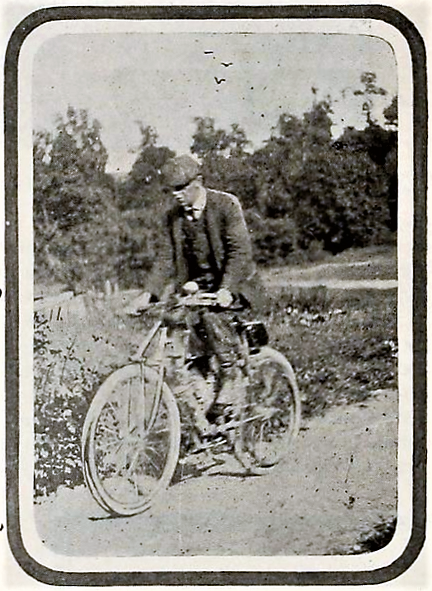
"When I left Colfax on the morning of May 19, the motor working grandly, and though the going was up, up, up it carried me along without any effort for nearly 10 miles. Then it overheated, and I had to "nurse" it with oil every three or four miles. It recovered itself during luncheon at Emigrants' Gap, and I prepared for the snow that had been in sight for hours and that the atmosphere told me was not now far ahead. But between the Gap and the snow there was six miles of the vilest road that mortal ever dignified by the term. Then I struck the snow, and as promptly I hurried for the shelter of the snow sheds, without which there would be no travel across continent by the northern route. The snow lies 10, 15, and 20-feet deep on the mountain sides, and ever and anon the deep boom or muffled thud of tremendous slides of "the beautiful" as it pitches into the dark deep canyons or falls with terrific force upon the sheds conveys the grimmest suggestions. The sheds wind around the mountain sides, their roofs built aslant that the avalanches of snow and rock hurled from above may glide harmlessly into the chasm below. Stations, section houses, and all else pertaining to the railways are, of course, built in the dripping and gloomy, but friendly, shelter of these sheds, where daylight penetrates only at the short breaks where the railway tracks span a deep gulch or ravine.
Summit Hotel, c.1900

To ride a motor bicycle through the sheds is impossible. I walked, of course, dragging my machine over the ties for 18 miles by cyclometer measurement. I was 7 hours in the sheds. It was 15 feet under the snow. That night I slept at Summit, 7,015 feet above the sea, having ridden - or walked - 54 miles during the day."

Community Memorials


Across America on a Motor Bicycle - "Over the Sierra's and Through the Snow Sheds" by George A. Wyman, The Motorcycle Magazine, June 1903, Vol 1 No 1
San Francisco, CA to Reno, NV
May 16 to May 20, 1903


Subscribe to get email updates of our...  
'What's New' to You!" 

Sunday, May 17, 2026

May 18 - Across America on a Motor Bicycle

(Sacramento to Colfax, CA)

"It was late when I awoke, and almost noon when I left the beautiful capital of the Golden State. The Sierras and a desolate country were ahead, and I made preparations accordingly. Sacramento's but 15 feet above sea level; the summit of the range is 7,015 feet.

Three and a half miles east of Sacramento the high trestle bridge spanning the main stream of the American River has to be crossed, and from this bridge is obtained a magnificent view of the snow-capped Sierras, "the great barrier that separates the fertile valleys and glorious climate of California from the bleak and barren sagebrush plains, rugged mountains, and forbidding wastes of sand and alkali that, from the summit of the Sierras, stretch away to the eastward for over a thousand miles." The view from the American River bridge is imposing, encompassing the whole foothill country, which "rolls in broken, irregular billows of forest crowned hill and charming vale, upward and onward to the east, gradually growing more rugged, rocky, and immense, the hills changing to mountains, the vales to canyons until they terminate in bald, hoary peaks whose white, rugged pinnacles seem to penetrate the sky, and stand out in ghostly, shadowy outline against the azure depths of space beyond."


G.Wyman
A few miles from Sacramento is the land of sheep. The country for miles around is a country of splendid sheep ranches, and the woolly animals and the sombreroed ranchmen are everywhere. Speeding around a bend in the road I came almost precipitately upon an immense drove which was being driven to Nevada. While the herders swore, the sheep scurried in every direction, fairly piling on top of each other in their eagerness to get out of my path. The timid, bleating creatures even wedged solidly in places. As they were headed in the same direction I was going, it took some time to worry through the drove.

The pastoral aspect of the sheep country gradually gave way to a more rugged landscape, huge boulders dotting the earth and suggesting the approach to the Sierras. At Rocklin the lower foothills are encountered; the stone beneath the surface of the ground makes a firm roadbed and affords stretches of excellent goings. Beyond the foothills the country is rough and steep and stony and redolent of the days of '49. It was here and hereabouts that the gold finds were
Wyman at Colfax Depot, CA


made and where the rush and "gold fever" were fiercest. Desolation now rules, and only heaps of gravel, water ditches, and abandoned shafts remain to give color to the marvelous narratives of the "oldest inhabitants" that remain. The steep grades also remain, and the little motor was compelled to work for its "mixture". It "chugged" like a panting being up the mountains, and from Auburn to Colfax - 60 miles from Sacramento - where I halted for the night, the help of the pedals was necessary."

Community Memorials

Across America on a Motor Bicycle - "Over the Sierra's and Through the Snow Sheds" by George A. Wyman, The Motorcycle Magazine, June 1903, Vol 1 No 1
San Francisco, CA to Reno, NV
May 16 to May 20, 1903


Subscribe to get email updates of our...  
'What's New' to You!" 

Saturday, May 16, 2026

May 17 - Across America on a Motor Bicycle

(Vallejo to Sacramento, CA)

"At 7:20 o'clock the next morning I said goodbye to my hospitable hosts and to the Pacific, and turned my face toward the ocean that laps the further shore of America. I at once began to go up in the world. I knew I would go higher; also I knew my mount. I was traveling familiar ground. During the previous summer I had made the journey on a California motor bicycle to Reno, Nevada, and knew that crossing the Sierras, even when helped by a motor, was not exactly a path of roses. But it was that tour, nevertheless, that fired me with desire to attempt this longer journey - to become the first motorcyclist to ride from ocean to ocean.

 For thirteen miles out of Vallejo the road was a succession of land waves; one steep hill succeeded by another, but the motor was working like clockwork and covered the distance in but a few moments over the hour, and in the face of a wind the force of which was constantly increasing. The further I went the harder blew the wind. Finally it actually blew the motor to a standstill. I promptly dismounted and broke off the muffler. The added power proved equal to the emergency, and the wind ceased to worry. My next dismount was rather sudden. While going well and with no thought of the road I ran full tilt into a patch of sand. I landed ungracefully, but unharmed, ten feet away. The fall, however broke my cyclometer and also cracked the glass of the oil cup in the motor - damage which the plentiful use of tire tape at least temporarily repaired.

 Entering the splendid farming country of the Sacramento Valley, it is easy to imagine this the garden spot of the world. Magnificent farms, well-kept vineyards and a profusion of peach, pear, and almond orchards line the road; and that scene so common to Californians' eyes and so odd to visitors' - great gangs of pigtailed Chinese at work with the rake and hoe - is everywhere observable. 


Sacramento River Flood, G.Wyman
At Davisville, 59 miles from Vallejo, those always genial and well meaning prevaricators, the natives, informed me that the road to Sacramento, which point I had set as the day's destination, was in good shape; and though I knew that in many places the Sacramento River, swollen by the melting snow of the Sierras, had, as is the case each year, overflowed its banks. I trustingly believed them. Alas! for human faith. Eight miles from Davisville the road lost itself in the overflowing river. The water was too deep to navigate on a motor bicycle or any other bicycle, so I faced about and retraced the road for four miles, or until I reached the railroad tracks.

Source: USGS, 1905
 The river and its tributaries, and for several miles the lowlands, are spanned by trestlework, on which the rails are laid. The crossties of the roadbed proper are not laid with punctilious exactitude, nor are the intervening spaces leveled or smoothed. They make uncomfortable and wearying walking: they make bicycle riding of any sort dangerous when it is not absolutely impossible. On the trestles themselves the ties are laid sufficiently close together to make them ride-able – rather "choppy" riding, it is true, but much faster and less tiresome than trundling. I walked the road-bed; I "bumped it" across the trestles and that night, the 17th, I slept in Sacramento, a day's journey of 82 miles and slept soundly."

Community Memorials

Across America on a Motor Bicycle - "Over the Sierra's and Through the Snow Sheds" by George A. Wyman, The Motorcycle Magazine, June 1903, Vol 1 No 1
San Francisco, CA to Reno, NV
May 16 to May 20, 1903


Subscribe to get email updates of our...  
'What's New' to You!" 


Friday, May 15, 2026

May 16 - Across America on a Motor Bicycle

At Lotta's Fountain
Market & Kearney Streets
(San Francisco to Vallejo, CA)

"Little more than three miles constituted the first day's travel of my journey across the American continent. It is just three miles from the corner of Market and Kearney streets, San Francisco, to the boat that steams to Vallejo, California, and, leaving the corner formed by those streets at 2:30 o'clock on the bright afternoon of May 16, less than two hours later I had passed through the Golden Gate and was in Vallejo and aboard the "Ark," or houseboat of my friends, Mr. and Mrs. Brerton, which was anchored there. I slept aboard the "Ark" that night."

Across America on a Motor Bicycle - "Over the Sierra's and Through the Snow Sheds" by George A. Wyman, The Motorcycle Magazine, June 1903, Vol 1 No 1
San Francisco, CA to Reno, NV
May 16 to May 20, 1903


George A. Wyman made a ceremonial start of his transcontinental motorcycle ride from this spot at 2:30 p.m. It was known as “Newspaper Square” at the time. Wyman’s transcontinental attempt was being underwritten by The Goodman Company, NYC, to help launch their new publication “The Motorcycle Magazine.”  Seven weeks of hard riding would begin the following day from the eastern shore of San Francisco Bay.  Wyman likely road by the California Motor Company location at 305 Larkin Street on his way to the ferry terminal. The direct route along Market St to the Vallejo Ferry terminal is less than one mile. However, the distance from Lotta’s Fountain to the California Motor Company, then on to the ferry terminal, is about 3 miles.

Community Memorials

Subscribe to get email updates of our...  
'What's New' to You! 


Saturday, May 9, 2026

The Story Behind the Headlines?

California Motor Company offers bicycle racer George Wyman $500 prize money to ride their motor-bicycle from San Francisco to New York City.  The Goodman Company gets exclusive rights to publish the story and helps with the trip expenses.

Filling the holes of the Wyman saga based on reliable and verifiable sources is a pains taking process.  Very much like a detective following leads, running down rumors and piecing the timeline together.  Sometimes, a new piece of the puzzle helps others fall into place.  When a new bit of the history surfaces, the Wyman Project is eager to share with the public.  Speculating about historical events beyond that supported by documented facts is a risky undertaking.  We want to present the information in historical context, offering reasonable assumptions about the circumstances surrounding new information.  The Wyman Project is very curious about the circumstances leading up to the first crossing of America by motorized vehicle. What were the stakeholders interests and motivations?  What did each hope to gain?  What follows is speculation about the story behind the documented tidbits.  We preface our assumptions with the phrase, "It is likely..."

FOLLOW THE MONEY - Investigations by Marti Wyman Schein, Research Director of the Wyman Project, and those published by Road Rider Magazine in September of 1988 point to a collaboration of the California Motor Company (CMC) and the Goodman Company, publisher of The Motorcycle Magazine, bank rolling much of, if not all of Wyman's historic 1903 journey.  It is likely the CMC put up prize money and would provide technical support.  The Goodman Company likely covered most of Wyman's trip expenses in exchange for exclusive story rights.  Wyman would keep a day-to-day journal and submit regular reports to the Goodman Company.

Dateline May 21, 1903 - Reno Gazette-Journal:  This news clipping confirms other rumors that Wyman would receive a $500 prize (Over $18,000 in 2026 dollars) if he arrived in New York City within 40 days from leaving San Francisco.  It is likely this information came from Wyman himself, given to the reporter for the Gazette-Journal.  Wyman was always eager to tell his story to the local news.  It was repeated in the Winnemucca paper a few days later.

The researchers at Road Rider Magazine make the case the CMC may have been heavily involved with the Wyman adventure.  The questions raised in that article are still unanswered to this day, as all records of the behind the scenes activities and motivations of the CMC owners are long gone.  But, the chronology of the events, juxtaposed with the contemporaneous reporting suggests a collaboration.  The California motor-bicycle was competing with scores of other motorized cycles.  Having invested large sums of startup capital in the CMC, the owners would have been eager to show how well the California performed.  (See the Wyman chronology, 1877 - 1959, in the Road Rider article, linked below.)

"America's First Road Rider - THE HISTORY, "Speculation on the Wyman Story" by G.W. 'Oley' Knudsen and Bob Carpenter, Road Rider Magazine, September 1988, Vol 19 Nbr 9

THE CALIFORNIA MOTOR COMPANY - At the turn of the last century, J.W. Leavitt and L.H. Bill owned/operated bicycle shops in the San Francisco, Oakland and San Jose, CA.  In 1901, Leavitt and Bill founded the California Motor Company.  They hired Roy C. Marks as chief mechanical engineer.  Their goal was to mass produce the motorized bicycle, dubbed the 'California', based on Marks design.  The CMC factory was located at the San Francisco bicycle shops at 730 & 309 Larkin Street.  The CMC was struggling to expand the market for its California motor-bicycle.  Something of a 'dud', its first model was just 90cc and 1/2 horsepower.  At that displacement it was prone to mechanical breakdowns as the under powered motor labored to carry a rider.  In 1902 the California was fitted with a larger 200cc, 1.25 HP motor.  If Leavitt & Bill could not make CMC profitable though the sales of the 'California' at least they could make the company attractive on the ever expanding motorcycle production market.

Cycling sports entrepreneurs Leavitt & Bill were active in the bicycle racing scene in the bay area, sponsoring an annual 100 mile bicycle rally event.   They knew top seeded bicycle racer George Wyman.  He participated in the bay area rallies in 1901 and 1902 after his return from Australia. Wyman had an international reputation for hard riding.  While in Australia around 1900 Wyman circumnavigated the continent of Australia on a bicycle, becoming the first American cyclist to do so.  Owing to his reputation for hard riding it is likely Wyman was eager to expand his riding horizons with a motor.  Sometime in 1902, Wyman acquired a California motor-bicycle.  It is not yet known how he came to get the bike, whether new from CMC or used from someone, or how much he paid for it.  Motor-bicycles in 1902 were retailing for between $200 and $250 ($5,000-$6.900 in 2017 dollars).   In July of 1902, Wyman rode 'the California' across the Sierra Nevada Mountains to attend the "Fifty Mile Bicycle Race" in Reno, NV (source:  Bicycling World and Motorcycle Review, page 255, April 1903)  Wyman was the first to ride a motorized vehicle, of any kind, across the Sierra Nevada range.  It was on the ride back to San Francisco that would inspired Wyman to attempt a transcontinental journey.

On August 17th, 1902, a large combined race featuring events for bicycles, motor-bicycles, and automobiles is held at San Francisco's Ingleside Racetrack.  Two California motor-bicycles are entered in the 5th event, a three-mile motor-bicycle handicap.  Wyman attended, but was not one of the California racers.  He was at the event, representing the Bay City Wheelmen, riding in three bicycle races. It is likely he watched the two California and one Thomas motor-bikes race.

Late summer or early fall, 1902, it is likely Wyman and the CMC got together to discuss his transcontinental attempt.  Wyman would need financial and technical support for the journey.  Whether he approached CMC or they came to him, we suspect the company and the racer came to an arrangement.  CMC would have seen the transcontinental attempt as an opportunity to showcase the California.  It is likely, CMC offered Wyman a $500 incentive if he could reach New York City in 40 days.  From their standpoint it was a calculated business decision.  If Wyman pulls it off it would be a huge endorsement of the quality of the California  and enhance the value of the CMC for any potential buy-out scenario.  If he did not make it with the 40 days, then all CMC was on the hook for was a New York City to San Francisco 1st Class train ticket for Wyman.  Given their inside knowledge of the performance capabilities of the California it seemed like a good business decision.  Wyman's planned route was slightly over 3,800 miles.  Making the journey in 40 days meant he had to cover an average of 95 miles each day.  CMC might have doubted Wyman's ability to make the journey in under 40 days, so no payout.  But, probably confident, given Wyman's reputation as a 'sticker' to eventually reach New York City.  There would be very little downside for CMC...except for bad press if things went wrong.

THE GOODMAN COMPANY - Publisher of the widely read "Bicycling World and Motorcycle Review", Goodman was keen to launch America's first periodical focusing on the growing motorcycle trend.  The first ad for the new magazine appears in the May 2, 1903 edition of "Bicycling World and Motorcycle Review."

Wyman had an agreement with Goodman to publicize the journey.  Wyman would provide timely and regular progress reports from the trail.  For exclusive rights to Wyman's articles and photographs, Goodman would provide reasonable travel and communication expenses, giving Wyman something like 'reporter' status. The Goodman Company had a well honed reporting infrastructure already established from years of covering the bicycling news across America and internationally. (Goodman states it has 'exclusive' rights to Wyman's reporting on page one, after the ad, of the June 1903 issue, The Motorcycle Magazine.)

Communication with the Goodman offices, in either San Francisco or New York City, were made by telephone, telegraph and postal mailings.  Wyman kept a paper journal of his journey and took photographs with a Kodak Vest Pocket camera.  Every few days while on the trip Wyman would have to compile his notes, get film developed and have the reports sent to Goodman.  The June 1903 premier issue of "The Motorcycle Magazine" featured the first installment of "Across America on a Motor Bicycle"  by Wyman.  During his ride, the Goodman Company published many news clips in "Bicycling World and Motorcycle Review" chronicling Wyman's journey in the April - September 1903 issues.  This periodical had a much higher circulation and subscription rate than the just launched "Motorcycle Magazine" so it was important for the Goodman Company to keep interest in the Wyman story high.

CMC - Wyman - Goodman:  The April 25, 1903 issue of Bicycling World and Motorcycle Review contains a clip announcing Wyman's intention to ride across America.  By this time it is likely the stage was set between the CMC, Wyman and the Goodman Company.  This begins the coverage of what could be the motor sports story of the century...or not.

One of the questions raised by Road Rider in the September 1988 article is: Why so little publicity about the historic first ever motorized vehicle journey across America?  Articles and news postings about the crossing appeared mainly in the local news papers, Bicycling World and Motorcycle Review and of course The Motorcycle Magazine.  All low circulation periodicals.

Another curiosity is the almost complete lack of any mention of the California brand in any of the published articles and the absence of the CMC logo in any photographs of the bike Wyman was riding, and no CMC advertising found before or during the ride.  Wyman mentions the California brand in just the first of his 5 "Across America on a Motor-Bicycle" articles.  And, that mention describes the California in a non-possessive manner describing his ride over the Sierra's, "During the previous summer I had made the journey on a California motor bicycle to Reno, Nevada..."  Note, he calls it as 'a California,' not 'my California.'   There is scant (only 1) mention of Wyman riding a California in news reports published in "Bicycling World and Motorcycle Review" during his May - July trip.

Could it be CMC imposed a temporary moratorium on Goodman Company and Wyman not to mention California brand until after successful completion of the trip?  It makes sense if CMC wanted to manage the publicity to minimize the negative impact of catastrophic failure of the motor.  Wyman's reference to 'a California', not 'my California' lends credibility to that idea owing to the successful first crossing of the Sierra Nevada Mountains by him on the California.  A contrary speculation is Wyman was at odds with CMC and refused to mention the California by name.  But that is not likely.  CMC would have done extensive advertising about its top of the line motor-bicycle going across America.  Without access to the agreement documentation, if any still exists, we my never know the true circumstances surrounding the relationships among the three stakeholders in this historic event.

All Fame Is Fleeting

Wyman rides the California across America in 50 days.  He misses the 40 day prize money window due to the many mechanical breakdowns and parts delays.  Wyman gets his 1st Class train ride back to San Francisco.  (Imagine his thoughts as he gazed out of the train window while traveling back along the route he just rode.)  His epic accomplishment rapidly fades into obscurity as the news of the first transcontinental crossing by automobile captures the imagination of America.

The Goodman Company launches "The Motorcycle Magazine" and proclaims Wyman a two-wheel motor sports hero.  Publishing the account of Wyman's San Francisco to New York City journey documents the first coast-to-coast long-distance motorcycle ride for posterity.  The magazine goes out of publication in 1906.

In October of 1903, the California Motor Company is sold to Consolidated Manufacturing, maker of the Yale brand of bicycles and motorcycles.  The negotiations for such a buy-out must have been in the works for months.  The following year, the machinery of the CMC in the San Francisco factory is disassembled and moved to the Yale factory in Toledo, OH.  The California-Yale is produced for a couple of years before going out of production.

The Spirit of the Long Ride

The legacy of Wyman's epic journey is not in his motivations or personal rewards.  That he kept going after missing the 40 day prize money window shows he was riding for other reasons.  He had to know finishing the first ever crossing of America by motorcycle was the extraordinary achievement in itself.  The legacy of George A. Wyman's successful 1903 ride across America literally defines the spirit of the long-distance motorcyclist.

Read -  Across America on a Motor Bicycle by George A. Wyman

Thursday, April 23, 2026

Wyman Declares Transcontinental Ride

The Bicycling World and Motorcycle Review, April 25, 1903


With the help of the California Motor Company and Goodman publishing, Wyman finalizes preparations for his epic motor-cycle ride across America.  It is likely this two sentence news clipping was the first public notice of Wyman's attempt.  It would be the beginning of publicity designed to launch The Goodman Company's new periodical, "The Motorcycle Magazine."


Since the California Gold Rush days, the distance between San Francisco and New York City set the standard for cross continent travel.  The completion of the transcontinental railway shortened a grueling eight week wagon journey to a relatively comfortable 83 hour express train ride

Iron Butt Magazine, Spring 2013
Wyman's 50 day motorized journey from San Francisco to New York City represented the next step in the technology of personal transcontinental travel.  Today, on modern motorcycles, members of the Iron Butt Association pay tribute to Wyman's legacy, making the San Francisco to New York City ride in under 50 hours.  

George A. Wyman...
"World's Toughest Motorcycle Rider, circa 1903"